

Research overview · John Powers
There has been a significant amount of research and discussion recently about how data centers can operate more flexibly to reduce stress on the electricity grid and accelerate their connection to power. Research from Duke University and Brattle has shown that there may be significant opportunities to connect new large loads by agreeing to reduce their electricity consumption during the relatively small number of hours when the grid is most constrained. More recently, OpenAI has made commitments to provide flexible demand response in Georgia, and other hyperscalers are pursuing similar approaches. I think these are important developments that can help make better use of the grid infrastructure we already have while protecting reliability and avoiding or deferring expensive new investments.
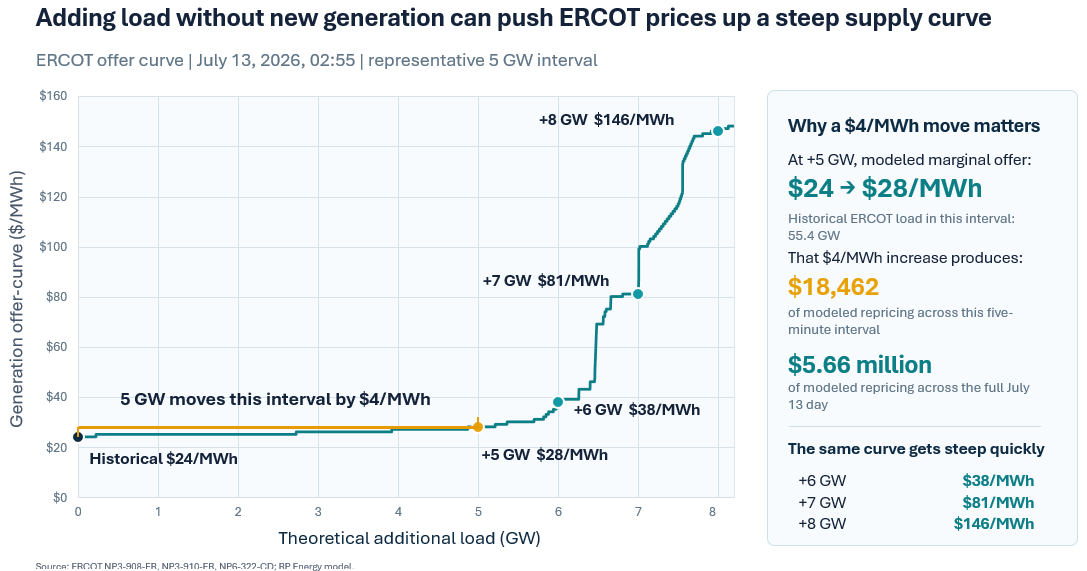
But there has been considerably less research into what happens to electricity prices during all the other hours when those new data centers are operating. Even when a new load is flexible enough to avoid increasing the system's historical peak demand, it can still change which generators are called upon to produce electricity, potentially increasing the wholesale price paid across the broader market. In competitive electricity markets like ERCOT in Texas, generators generally offer their power into the market based on their cost of production, and the marginal or last generator needed to meet demand can influence the price paid for electricity across the system. Adding new demand pushes the market further up that generation supply stack, which can have significant consequences for existing electricity customers even if the new load never creates a new system peak.
This distinction between physical grid capacity and the economic impact of adding load is what we set out to examine in our new RP Energy paper, The Grid Has Room. Does the Market?
What we found in ERCOT
We modeled the impact of adding between 1 and 10 GW of new electricity demand to ERCOT using ten months of actual five-minute market data, from December 5, 2025 through October 4, 2026. We compared the wholesale price impacts of adding the load without flexibility, with enough curtailment to avoid setting a new historical system peak, and with additional curtailment triggered by electricity prices. The objective was to understand how much existing wholesale electricity costs might increase if significant new load connected before the new generation intended to serve it came online.
The results were significant. At 5 GW of additional load, a data center could have consumed approximately 99.1% of its potential electricity while avoiding a new system peak, requiring less than 1% curtailment. Yet our model found approximately $4.4 billion in additional wholesale electricity spending on existing ERCOT demand over the ten-month period. Adding a price trigger of $150/MWh reduced that amount to approximately $4.2 billion while still allowing the new load to consume 98.8% of its potential electricity. At higher levels of added load, the modeled price impacts increased dramatically, and price-responsive flexibility became much more valuable than flexibility tied only to the historical system peak.
| Added load | No curtailment | Peak-neutral | $150/MWh curtailment |
|---|---|---|---|
| 1 GW | $0.891B | $0.891B | $0.877B |
| 3 GW | $2.485B | $2.478B | $2.425B |
| 5 GW | $4.439B | $4.395B | $4.207B |
| 7 GW* | $15.348B | $14.044B | $8.560B |
| 10 GW* | $144.253B | $118.209B | $18.826B |
* At 7 and 10 GW, some scenarios extend beyond the published supply-curve quantity. These cases are subject to the offer-stack boundary limitations in the approved paper, Section 3 and Appendix A6. Source: full paper, Table 1. These are modeled wholesale impacts, not retail bill forecasts.
These results do not mean that every data center will increase electricity bills by these amounts. Our study is a historical counterfactual that holds the existing generation supply stack constant, rather than modeling all the new generation and market responses that would occur over time. The results also represent gross wholesale repricing rather than actual retail bill increases, which depend on contracts, hedges and rate structures. New loads also contribute toward the cost of existing transmission infrastructure, which benefits other customers, although our analysis indicates that this benefit offsets only a relatively small portion of the modeled wholesale repricing in the scenarios we examined.
What the analysis does suggest is that simply preventing new loads from increasing the system peak may not be enough to protect other electricity customers from higher energy costs.
A three-part approach to protecting ratepayers
We believe there is a practical way to address this while continuing to accelerate data-center development, and it involves three complementary approaches.
The first is to make new large loads meaningfully flexible, with the ability to reduce their demand not only when the grid is approaching its peak but also when electricity prices become expensive. This could involve shifting computing workloads, using batteries or behind-the-meter generation, or contracting with virtual power plants that reduce demand elsewhere on the grid. Our results show that flexibility tied to electricity prices can provide additional benefits by reducing demand during the hours when the market is most sensitive to incremental consumption.
The second is to bring new generation that actually reduces the cost of electricity in the market. This is an important distinction from simply matching a data center's annual electricity consumption with new generation purchases. Adding low-marginal-cost generation at the right times and locations can move the market back down the generation supply stack and reduce wholesale electricity prices for everyone. We are already seeing promising examples of hyperscalers investing in nuclear uprates, renewables, storage and virtual power plants, and we believe that understanding which combinations deliver the greatest market-wide benefits is an important area for additional research.
The third is to establish mechanisms to protect existing electricity customers from any remaining costs, particularly during the period between a data center connecting to the grid and the new generation intended to support it becoming operational. This could include dedicated tariffs, customer credits or other transparent arrangements that reflect the actual additional costs borne by existing customers. We also believe host communities should have an opportunity to participate more directly in the economic value being created, potentially through recurring community benefit funds rather than relying solely on one-time investments or commitments.
The economics suggest there is room to make this work
One reason we believe this framework is commercially feasible is the extraordinary economic value that AI operators can generate from access to electricity. Our Q3 2026 Compute Heat Rate estimates that an average new AI inference data center could theoretically pay approximately $5,631/MWh for electricity while still covering its modeled costs and margin. When we exclude sunk costs and look at the economic decision to keep an existing facility operating, our Dispatch Compute Heat Rate increases to approximately $9,071/MWh. These are modeled economic thresholds rather than actual electricity prices or data-center profits, but they help explain why speed to power is so valuable.
To put the potential ratepayer protection cost in perspective, in our 5 GW cases the modeled wholesale repricing works out to approximately $119–$124/MWh of electricity consumed by the new load, depending on the curtailment strategy. This is the illustrative amount required to offset the full modeled wholesale repricing, not a proposed tariff or an estimate of what individual ratepayers should receive. But it represents only about 2% of the Q3 Compute Heat Rate, suggesting there may be substantial economic room for data-center developers to fund flexibility, new generation and appropriate customer protections while still benefiting enormously from faster access to power.
The same economics also create an opportunity for community benefits. One idea we discuss in the paper is linking a recurring community fund contribution to a small percentage of the published Compute Heat Rate and the facility's metered electricity consumption. This could provide a transparent mechanism for host communities to participate in the economic upside of AI development without requiring operators to disclose the profitability of individual facilities. Such a fund would be separate from mechanisms intended to reimburse electricity customers for actual incremental costs.
The CHR and CHR-D figures above reproduce the supplied editorial text and approved paper; they are modeled Q3 2026 reference thresholds. See the published CHR Index for current values and methodology.
Where we go from here
I don't think we need to choose between accelerating AI infrastructure development and protecting existing electricity customers. Flexible loads can help us make better use of the grid we already have, new low-cost generation can offset the wholesale price impacts of additional demand, and well-designed financial arrangements can address remaining costs while creating benefits for the communities hosting these investments.
Our ERCOT analysis is a starting point, and we recommend several areas for additional study, including the impact of new generation on wholesale prices, how results vary by location, the role of virtual power plants and storage, and how wholesale market changes ultimately translate into retail electricity costs. We welcome feedback on our methodology and opportunities to collaborate with utilities, data-center developers, policymakers and other market participants interested in applying this approach to specific projects or other electricity markets.
The opportunity is to move beyond simply making enough physical room on the grid for AI and start designing projects that also make economic sense for the electricity customers and communities already there. Given the enormous economic value of getting computing infrastructure connected quickly, I believe we have the opportunity to accomplish both.
Download full paper (PDF)Share and cite
Permanent page address:
https://rpenergyinc.com/research/the-grid-has-room-does-the-market/Powers, John. “The Grid Has Room. Does the Market? A practical framework for powering AI growth while protecting electricity customers.” Royal Powers Energy, Inc., November 3, 2026.